



What is an echogenic needle nerve block used for?A Practical Guide for Anesthesiolog
Ultrasound-guided nerve blocks have become an important part of modern regional anesthesia because they allow anesthesiologists to visualize nerves, surrounding anatomical structures, the needle, and the spread of local anesthetic in real time. However, seeing the target anatomy is only part of the procedure. The needle tip must also remain clearly visible as it advances toward the target.
This is where an echogenic needle nerve block can provide an important advantage.
A disposable echogenic needle for anesthesiology is designed to produce stronger ultrasound reflections, making the needle shaft and tip easier to identify during ultrasound-guided procedures. This can be particularly useful when the needle is inserted at a steeper angle, placed deeper in tissue, or becomes difficult to distinguish from surrounding structures.
For hospitals, anesthesia departments, pain-management centers, and medical-device distributors, understanding what an echogenic needle is used for can help determine when this type of needle is appropriate and what specifications should be considered.
Key Takeaways
An echogenic needle is designed to improve needle visibility under ultrasound.
It is primarily used for ultrasound-guided regional anesthesia and peripheral nerve blocks.
Better needle-tip visualization can help clinicians maintain awareness of needle position during advancement and injection.
Echogenicity becomes especially relevant when the needle is inserted at a steep angle or into deeper tissue.
An echogenic needle does not replace ultrasound skills, appropriate scanning technique, aspiration, injection-pressure awareness, or clinical monitoring.
Disposable designs can support standardized infection-control practices when used according to the applicable instructions for use.
Needle gauge, length, tip design, extension tubing, and ultrasound visibility should all be considered when selecting a product.
What Is an Echogenic Needle?
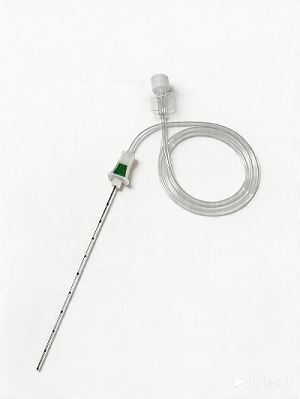
An echogenic needle is a needle specifically designed to produce a stronger or more consistent ultrasound echo than a conventional needle.
During ultrasound-guided regional anesthesia, the ultrasound probe sends sound waves into the tissue. When these waves encounter the metal needle, some of the acoustic energy is reflected back toward the transducer. The ultrasound system then displays the returning signal as an image.
The challenge is that needle visibility can change according to the insertion angle, needle orientation, tissue depth, ultrasound beam position, and other procedural factors.
Research has demonstrated that enhanced echogenicity can improve visualization of the needle shaft and tip during ultrasound-guided regional anesthesia. One randomized clinical study comparing echogenic and conventional needles found better objective and subjective needle-tip visibility with the echogenic design.
Therefore, the main purpose of a disposable echogenic needle for anesthesiology is not to change the anesthetic itself. Its purpose is to help the clinician identify and track the needle under ultrasound.
What Is an Echogenic Needle Nerve Block Used For?
The primary application is ultrasound-guided peripheral nerve block.
During a nerve block, the clinician uses ultrasound to identify the target nerve and nearby structures. The needle is then advanced under real-time imaging toward the intended injection location.
An echogenic needle nerve block can be used when the clinician needs improved visualization of the needle during this process.
| Application | Purpose of Ultrasound Guidance | Potential Value of an Echogenic Needle |
|---|---|---|
| Brachial plexus block | Identify nerves and surrounding structures | Improve needle-tip tracking |
| Femoral nerve block | Locate the femoral nerve region | Help maintain needle visibility |
| Sciatic nerve block | Guide the needle toward the target region | Useful when greater depth makes visualization difficult |
| Adductor canal block | Identify the target anatomy | Support real-time needle positioning |
| Interscalene block | Identify the brachial plexus | Help monitor the needle path |
| Other peripheral nerve blocks | Guide targeted regional anesthesia | Improve ultrasound visibility of the needle |
The exact technique, approach, needle length, and anesthetic plan should always be determined by a qualified healthcare professional according to the patient, target anatomy, clinical indication, and applicable clinical protocols.
Why Is Needle Visibility Important in Ultrasound-Guided Nerve Blocks?
Ultrasound guidance provides real-time anatomical information, but the needle can sometimes become difficult to see.
One important factor is the angle between the needle and the ultrasound beam. As the insertion angle becomes steeper, the amount of ultrasound energy returning directly to the transducer may decrease. This can make the needle shaft or tip less distinct.
A review of echogenic technology in regional anesthesia reported that echogenic needles can improve shaft and tip visibility and may be particularly useful when needles are inserted at steeper angles.
This is one reason a disposable echogenic needle for anesthesiology may be considered for procedures in which needle visualization is technically challenging.
However, improved echogenicity should be viewed as a visualization aid rather than a guarantee of procedural safety. Ultrasound-guided regional anesthesia still requires appropriate patient assessment, ultrasound technique, needle control, injection technique, and monitoring.
How Does an Echogenic Needle Work?
The design of an echogenic needle aims to increase the amount of ultrasound energy reflected back toward the ultrasound transducer.
Different manufacturers may use different surface structures, reflective features, or tip designs to achieve this effect.
For example, ShineArk Medical's AN-N/AN-M series uses a 4×4 micro-reflective structure designed to enhance acoustic reflection. The manufacturer's product information describes a 360° acoustic reflection approach intended to maintain needle visibility across different insertion angles.
The basic principle can be understood simply:
Ultrasound probe → Acoustic waves → Needle surface → Reflected ultrasound signal → Visible needle image
The more clearly the needle appears on the ultrasound screen, the easier it may be for the clinician to identify the shaft and tip during advancement.
Importantly, echogenicity is influenced by more than the needle itself. Probe position, needle angle, ultrasound settings, tissue characteristics, depth, and operator technique also affect visibility.
When Is a Disposable Echogenic Needle for Anesthesiology Especially Useful?
1. Steeper Needle Insertion Angles
Steep needle angles can reduce the amount of reflected ultrasound energy returning to the probe. Clinical research has shown that enhanced echogenicity can improve visibility under these conditions.
2. Deeper Target Structures
As the needle travels deeper into tissue, maintaining a clear image can become more difficult. Selecting an appropriate needle length and ultrasound-compatible design can therefore be important.
3. Procedures Requiring Precise Needle Tracking
When the needle must be advanced carefully toward a defined anatomical target, continuous awareness of the needle tip is essential.
4. Ultrasound-Guided Regional Anesthesia Training
For clinicians developing ultrasound-guided regional anesthesia skills, clear visualization of the needle can make it easier to understand the relationship between the needle and the ultrasound image.
Nevertheless, echogenicity does not replace training or clinical experience.
Echogenic Needle vs. Conventional Needle
The main difference is the needle's visibility characteristics under ultrasound.
| Feature | Conventional Needle | Echogenic Needle |
|---|---|---|
| Ultrasound visibility | Depends strongly on angle and technique | Designed for enhanced visibility |
| Needle-tip tracking | May become difficult at certain angles | Intended to improve tip visibility |
| Steep-angle procedures | Visualization may be more challenging | Enhanced echogenicity may provide an advantage |
| Ultrasound-guided nerve blocks | Commonly used | Specifically useful when visibility is a concern |
| Operator requirements | Requires appropriate ultrasound skills | Still requires appropriate ultrasound skills |
| Safety role | Visualization is one part of safe practice | Improved visibility is an aid, not a guarantee of safety |
Studies comparing regional anesthesia needles have found meaningful differences in echogenicity among needle designs. One study involving 11 regional block needles found that needles marketed as hyperechoic received higher echogenicity scores than standard needles.
What Features Should Buyers Look for in an Echogenic Nerve Block Needle?
For hospitals, distributors, and procurement teams, echogenicity should not be the only purchasing criterion.
A suitable disposable echogenic needle for anesthesiology should also be evaluated for:
Needle Gauge and Length
Different nerve blocks require different needle dimensions. A product range covering multiple gauges and lengths can help meet different procedural requirements.
ShineArk Medical's AN-N and AN-M series currently lists multiple configurations, including 20G, 21G, 22G, 23G, 24G, and 25G options, with different needle lengths.
Needle Tip Design
The tip influences tissue entry, handling characteristics, and clinician preference. ShineArk Medical's product is described as using a bilateral back-bevel design.
Material
Medical stainless steel is commonly used for needles because it provides the mechanical properties required for controlled insertion.
ShineArk Medical specifies 304 medical stainless steel for its AN-N/AN-M series.
Extension Tubing
An extension tube can provide flexibility between the needle and injection system. The ShineArk product page specifies a 500 mm TPU extension tube for its nerve block needle series.
Manufacturing and Quality Systems
For institutional purchasing, buyers should also evaluate the manufacturer's quality-management system, applicable regulatory documentation, production environment, traceability, packaging, sterilization status, and instructions for use.
ShineArk Medical states that its nerve block needles are manufactured in a Class 8 cleanroom and that the company operates under ISO 13485 and European MDR-related quality and regulatory requirements. Buyers should verify the applicable certificates and technical documentation for their target market before procurement.
Is an Echogenic Needle Safer Than a Conventional Needle?
It is more accurate to say that an echogenic needle may improve needle visualization, rather than claiming that it is automatically safer.
Needle-tip visualization is an important component of ultrasound-guided regional anesthesia. Evidence shows that echogenic needle designs can improve visualization under certain conditions.
However, patient safety depends on multiple factors, including:
Appropriate patient selection
Knowledge of anatomy
Ultrasound scanning technique
Continuous awareness of needle-tip position
Controlled needle advancement
Appropriate injection technique
Aspiration and monitoring practices
Recognition and management of potential complications
Ultrasound visualization does not replace other safety practices such as aspiration, attention to injection pressure, and appropriate clinical assessment.
Therefore, the best way to understand an echogenic needle is as a visualization-enhancing medical device used within a broader ultrasound-guided anesthesia technique.
Why Choose ShineArk Medical for Echogenic Nerve Block Needles?
ShineArk Medical focuses on ultrasound-visible needles designed for regional anesthesia and related procedures.
Its AN-N/AN-M series combines several features intended for ultrasound-guided applications, including enhanced acoustic reflection, a 4×4 micro-reflective structure, bilateral back-bevel tip design, 304 medical stainless steel, and a flexible TPU extension tube. The available specifications cover a range of gauges and lengths for different procedural requirements.
For international hospitals, distributors, and medical-device importers, ShineArk Medical also provides OEM/ODM support and states that its production is carried out in a Class 8 cleanroom with ISO 13485 and MDR-related technical support.
This combination makes ShineArk Medical a potential manufacturing partner for buyers looking for a disposable echogenic needle for anesthesiology rather than a general-purpose puncture needle.
How to Select the Right Echogenic Needle for Nerve Blocks
Before placing a bulk order, procurement teams should consider five practical questions:
1. What nerve blocks will the needle be used for?
The intended procedures determine the appropriate gauge and length.
2. What target depth is expected?
Deeper targets may require longer needles and careful consideration of ultrasound visibility.
3. Is needle-tip visibility sufficient at the required insertion angle?
Sample evaluation under the intended ultrasound system can provide useful practical information.
4. What regulatory documentation is required?
Requirements differ between markets, so buyers should confirm the applicable regulatory pathway before purchasing.
5. Can the supplier support OEM or volume procurement?
For distributors and hospital groups, packaging, labeling, specifications, documentation, MOQ, and production capacity can all affect procurement decisions.
Final Thoughts
So, what is an echogenic needle nerve block used for?
Its primary purpose is to support ultrasound-guided regional anesthesia by making the needle shaft and tip easier to visualize during nerve block procedures. This can be especially valuable when needle visibility is affected by insertion angle, target depth, or other technical factors.
A disposable echogenic needle for anesthesiology is therefore best understood as a specialized ultrasound-guided nerve block needle designed to support accurate needle visualization—not as a replacement for clinical expertise or standard safety practices.
For hospitals, anesthesiology departments, pain-management centers, and medical-device distributors, choosing the right product means looking beyond echogenicity alone. Needle dimensions, tip design, materials, extension tubing, quality systems, regulatory documentation, and supplier support should all be evaluated together.
ShineArk Medical provides ultrasound-visible nerve block needles in multiple configurations and supports OEM/ODM and international medical-device procurement requirements.
FAQ
What is a disposable echogenic needle for anesthesiology?
It is a single-use needle designed to provide enhanced visibility under ultrasound during regional anesthesia and nerve block procedures.
What is an echogenic needle nerve block used for?
It is used for ultrasound-guided peripheral nerve blocks, helping clinicians visualize and track the needle during positioning and injection.
Why use an echogenic needle for nerve blocks?
Its enhanced ultrasound visibility can make the needle shaft and tip easier to identify, particularly at challenging insertion angles or depths.
Are echogenic needles only used for nerve blocks?
No. Echogenic needle technology can be applied to other ultrasound-guided procedures, depending on the needle's intended use and regulatory labeling.
Does an echogenic needle make nerve blocks safer?
It may improve needle visualization, but it does not independently guarantee safety. Proper ultrasound technique, needle control, monitoring, and clinical protocols remain essential.
What gauges are available for ShineArk echogenic nerve block needles?
The AN-N/AN-M series includes multiple configurations from 20G to 25G, with different needle lengths.
Can ShineArk Medical provide OEM/ODM echogenic needles?
Yes. ShineArk Medical provides OEM/ODM support and custom packaging options for its products.
How should hospitals evaluate an echogenic nerve block needle?
Evaluate ultrasound visibility, gauge, length, tip design, materials, packaging, regulatory documentation, quality systems, and compatibility with the intended clinical workflow.
Please Contact Us!
Recent News
1.What Is an Ultrasound Needle for Regional Anesthesia and Biopsy
2026-08-192.What kind of needle is used for a nerve block?
2026-08-073.Echogenic Nerve Block Needles: How 360-Degree Laser-Engraved Micro-Structures Improve Ultrasound Visibility
2026-08-074.What Size Needle Is Typically Used for Peripheral Nerve Blocks? A Complete Guide to Gauge and Length Selection
2026-09-035.What is a puncture needle?
2026-06-266.How to Select the Right Peripheral Nerve Block Needle
2026-06-127.What's a Nerve Block Needle, and How Does It Work?
2026-06-088.Ultimate Guide to Ultrasound-Guided Nerve Block Needles: Safe, Precise, and Disposable Solutions
2026-05-29