



What Size Needle Is Typically Used for Peripheral Nerve Blocks? A Complete Guide to Gauge and Length Selection
Choosing the right needle size is an important part of performing an ultrasound-guided peripheral nerve block. The needle must be long enough to reach the target structure while providing sufficient control during advancement. At the same time, the gauge should balance handling, visibility, injection requirements, and patient comfort.
So, what size needle is typically used for peripheral nerve blocks?
In many single-shot peripheral nerve block procedures, a 22G peripheral nerve block needle is commonly used. However, 21G, 23G, 24G, and 25G needles may also be appropriate depending on the target nerve, tissue depth, patient anatomy, and procedural technique. There is no single needle size that is ideal for every peripheral nerve block.
For ultrasound-guided procedures, an echogenic puncture needle can provide an additional advantage by improving needle visibility on the ultrasound screen. This becomes particularly useful when the needle is inserted at a steeper angle or when the target is relatively deep.
Understanding the relationship between needle gauge, length, echogenicity, and clinical application can help anesthesiologists, hospitals, distributors, and medical-device buyers make more informed decisions.
Key Takeaways
A 22G needle is commonly used for many single-shot peripheral nerve blocks.
Needle selection should depend on the target nerve, depth, patient anatomy, and technique rather than gauge alone.
Smaller-gauge needles such as 23G–25G may be suitable for selected superficial procedures.
Longer or deeper procedures may require a needle with an appropriate combination of length and rigidity.
An echogenic puncture needle is designed to improve ultrasound visibility of the needle shaft and tip.
Needle length must be sufficient to reach the target without unnecessary needle advancement.
Continuous nerve block techniques may require a different needle system because a catheter must pass through the needle.
An appropriate peripheral nerve block needle supports procedural control but does not replace ultrasound skills or standard safety practices.
What Needle Gauge Is Commonly Used for Peripheral Nerve Blocks?
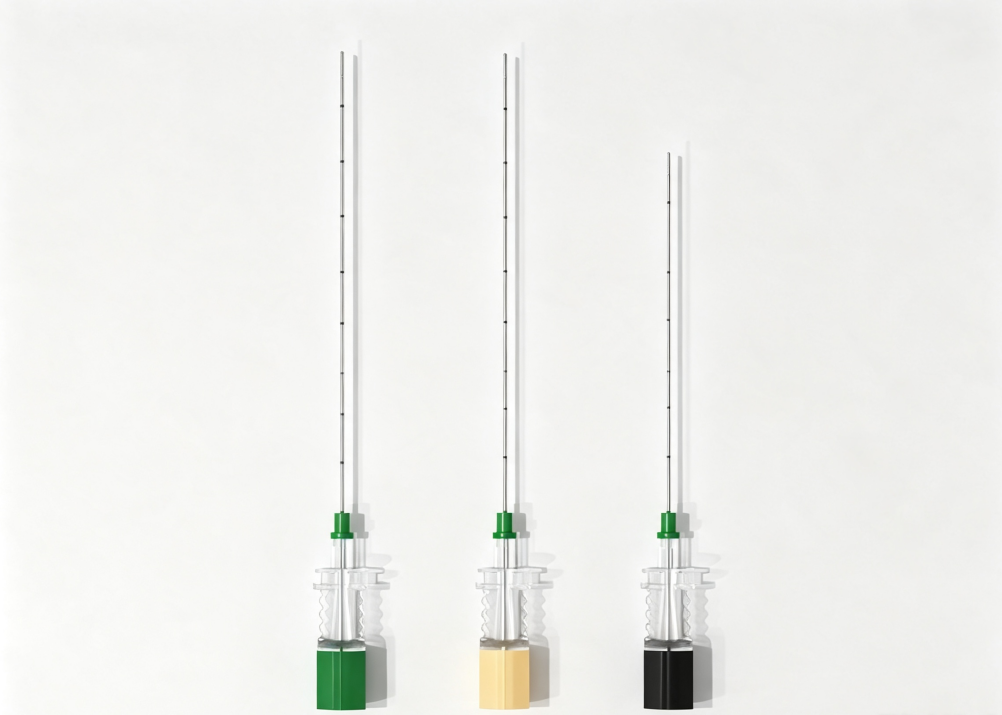
Needle gauge refers to the thickness of the needle. In the gauge system, a higher gauge number generally means a thinner needle.
For many single-shot peripheral nerve blocks, 22G is a commonly used size because it provides a practical balance between needle control, flexibility, patient comfort, and ultrasound visibility. Clinical equipment references identify 22G needles as a common choice for single-shot peripheral nerve blocks.
However, 22G should be regarded as a common starting point rather than a universal standard.
Depending on the procedure, clinicians may select a thinner 23G, 24G, or 25G needle, particularly when working with superficial structures. Larger needles may provide greater stiffness and handling control, which can be useful when longer needle lengths are required.
Typical Needle Gauge Selection
| Needle Gauge | Relative Needle Thickness | Potential Application | Main Consideration |
|---|---|---|---|
| 20G | Relatively large | Selected deeper procedures or specific applications | Greater stiffness and tissue penetration |
| 21G | Medium-large | Various peripheral nerve blocks | Balance of control and flexibility |
| 22G | Common choice | Many single-shot peripheral nerve blocks | Good balance of control and comfort |
| 23G | Thinner | Selected peripheral nerve blocks | Lower stiffness than larger gauges |
| 24G | Thin | Superficial or smaller-target procedures | May be more flexible |
| 25G | Very thin | Selected superficial procedures | Requires careful control and visualization |
The appropriate size should always be determined by a qualified clinician based on the intended procedure and patient anatomy.
Why Is 22G Often Used for Peripheral Nerve Blocks?
There are several practical reasons why a 22G peripheral nerve block needle is frequently selected.
First, it offers a reasonable level of stiffness. Very thin needles can bend more easily, particularly when a longer needle is required to reach a deeper target. Excessive bending can make precise needle advancement more difficult.
Second, the diameter of a 22G needle provides a useful balance between mechanical control and patient comfort. A needle that is too large may increase tissue trauma, while an excessively thin needle may be more flexible and potentially more difficult to steer.
Third, a 22G needle is generally compatible with many single-shot regional anesthesia techniques.
For these reasons, 22G is often considered a practical general-purpose size for single-shot peripheral nerve blocks, while other gauges remain important for specific clinical situations.
Does Needle Size Depend on the Nerve Block?
Yes. The anatomical location and depth of the target are major factors in needle selection.
A superficial target generally does not require the same needle length as a deep target. Similarly, a small superficial peripheral nerve may be approached differently from a deeper nerve surrounded by substantial soft tissue.
For example, clinical ultrasound-guided procedures may use 25G or 27G needles for small superficial peripheral nerves, while a larger 22G needle may be used when accessing larger or deeper nerves.
The important principle is:
Choose the smallest practical needle that provides adequate reach, control, and procedural performance.
The decision should not be based on gauge alone.
How Long Should a Peripheral Nerve Block Needle Be?
Needle length is just as important as gauge.
A needle must reach the intended anatomical target while leaving enough usable shaft outside the skin for controlled manipulation. If the needle is too short, the clinician may not be able to reach the target. If it is unnecessarily long, controlling and steering the needle may become more difficult.
Common peripheral nerve block needle lengths can range from approximately 50 mm to 150 mm, depending on the intended application and product design.
For example, the current ShineArk Medical AN-N/AN-M series provides multiple combinations, including 50 mm, 60 mm, 70 mm, 80 mm, 90 mm, 100 mm, 120 mm, and 150 mm configurations. This allows buyers to select a length according to the intended procedural depth.
Needle Length and Procedural Depth
| Target Situation | Typical Length Consideration | Selection Principle |
|---|---|---|
| Very superficial target | Short needle | Avoid unnecessary insertion depth |
| Superficial peripheral nerve | Around 50–70 mm may be suitable | Match actual tissue depth |
| Moderate-depth target | Around 70–100 mm may be considered | Balance reach and control |
| Deep peripheral nerve | Longer needle may be required | Ensure adequate working length |
| Large or deep patient anatomy | Longer options may be needed | Consider tissue depth and needle control |
These ranges are general selection considerations rather than fixed clinical requirements. The actual needle length should be determined by the clinician after assessing the patient's anatomy and ultrasound image.
Why Does Needle Length Affect Ultrasound-Guided Procedures?
Longer needles can provide the reach required for deep structures, but they can also introduce additional handling considerations.
A long, thin needle may be more flexible and can bend during advancement. This may make it harder to maintain the intended trajectory.
For ultrasound-guided procedures, the relationship between the needle and ultrasound beam is also important. Needle visibility can change depending on the insertion angle, orientation, depth, and ultrasound technique.
This is one reason an echogenic puncture needle can be valuable for regional anesthesia. Enhanced echogenicity is intended to make the needle more visible under ultrasound, particularly when visualization becomes technically challenging.
Professional literature reports that echogenic needles can improve needle-tip visibility, including at steeper insertion angles.
What Is an Echogenic Puncture Needle?
An echogenic puncture needle is designed to generate stronger or more consistent ultrasound reflections than a conventional needle.
During an ultrasound-guided nerve block, the ultrasound probe sends sound waves into the tissue. When the sound waves reach the needle surface, part of the acoustic energy is reflected toward the transducer.
The ultrasound system uses these returning signals to create an image.
The problem is that a conventional needle may become less visible when it is positioned at an unfavorable angle relative to the ultrasound beam. Echogenic designs use specialized surface structures or reflective features to improve the amount of returning ultrasound energy.
The goal is simple:
Better needle visibility → easier shaft and tip identification → improved real-time needle tracking.
An echogenic puncture needle should therefore be considered a visualization aid rather than a substitute for proper ultrasound technique.
Why Is an Echogenic Needle Useful for Peripheral Nerve Blocks?
Ultrasound-guided regional anesthesia depends on real-time visualization of anatomical structures and the advancing needle.
If the needle tip becomes difficult to identify, the clinician may need to adjust the ultrasound probe, change the needle angle, or reposition the needle.
An echogenic peripheral nerve block needle is designed to help address this visualization challenge.
This can be particularly relevant when:
The needle is inserted at a steep angle.
The target structure is relatively deep.
The needle shaft is difficult to distinguish from surrounding tissue.
The clinician needs continuous awareness of the needle tip.
A longer needle is required to reach the target.
Evidence and professional guidance support improved needle visibility as one of the potential benefits of echogenic needle designs in ultrasound-guided regional anesthesia.
However, improved visibility should not be interpreted as an automatic reduction in complications. Safe regional anesthesia also depends on appropriate patient assessment, anatomical knowledge, ultrasound technique, controlled needle advancement, injection technique, and monitoring.
How Do Gauge and Echogenicity Work Together?
Gauge and echogenicity solve different problems.
Gauge relates primarily to the physical characteristics of the needle, including diameter, stiffness, flexibility, and handling.
Echogenicity relates primarily to ultrasound visibility.
A needle can therefore have an appropriate gauge but still be difficult to visualize if its ultrasound characteristics are not suitable for the procedure.
Conversely, an echogenic needle still needs an appropriate gauge and length for the intended application.
For this reason, selecting a peripheral nerve block needle should involve more than asking, "What gauge is best?"
A better question is:
What gauge, length, tip design, and ultrasound visibility are appropriate for this specific procedure?
How Should Hospitals Select a Peripheral Nerve Block Needle?
Hospitals and medical-device procurement teams can evaluate several factors before purchasing.
1. Gauge
Determine whether the intended application requires a thinner or more rigid needle. A 22G option can serve many single-shot applications, while thinner gauges may be suitable for selected superficial procedures.
2. Length
Match the needle length to the expected target depth. The needle should provide adequate working length without creating unnecessary handling difficulties.
3. Ultrasound Visibility
For ultrasound-guided procedures, evaluate how clearly the shaft and tip can be identified. An echogenic puncture needle can be particularly useful when the approach involves challenging angles or deeper structures.
4. Tip Design
Tip geometry affects needle handling and tissue interaction. The selected design should be appropriate for the intended regional anesthesia application.
5. Material and Manufacturing Quality
Buyers should evaluate needle material, dimensional consistency, packaging, sterility, traceability, quality-management systems, and applicable regulatory documentation.
6. Product Range
For hospitals and distributors, a supplier offering multiple gauges and lengths can make procurement easier because different procedures may require different configurations.
ShineArk Medical Peripheral Nerve Block Needle Solutions
ShineArk Medical develops and manufactures ultrasound-visible needles for regional anesthesia and pain-management applications.
Its AN-N/AN-M series combines ultrasound-visible design with multiple gauge and length options. The current product specifications include configurations from 20G to 25G and lengths ranging from 50 mm to 150 mm, depending on the model.
The product is also designed with a bilateral back-bevel tip and a micro-reflective structure intended to enhance ultrasound reflection. ShineArk Medical states that its production is carried out in a Class 8 cleanroom and provides OEM/ODM support for international medical-device buyers.
For hospitals, distributors, and medical-device companies, this range allows the peripheral nerve block needle configuration to be matched more closely with different procedural requirements.
Final Answer: What Size Needle Is Typically Used?
So, what size needle is typically used for peripheral nerve blocks?
For many single-shot peripheral nerve blocks, 22G is a commonly used needle gauge because it provides a practical balance between control, flexibility, and patient comfort. However, 21G, 23G, 24G, and 25G needles may also be appropriate depending on the target nerve, depth, patient anatomy, and clinical technique.
Needle length must also be selected carefully. Superficial blocks may require shorter needles, while deeper targets may require longer configurations.
For ultrasound-guided procedures, an echogenic puncture needle can add value by improving visualization of the needle shaft and tip, especially when the needle is inserted at challenging angles or into deeper tissue.
The most appropriate needle is therefore not simply the one with the "correct" gauge. It is the one that provides an appropriate combination of gauge, length, tip design, ultrasound visibility, handling characteristics, and regulatory compliance for the intended application.
FAQ
What gauge needle is most commonly used for peripheral nerve blocks?
A 22G needle is commonly used for many single-shot peripheral nerve blocks, although other gauges may be appropriate depending on the procedure.
Is 22G or 25G better for a peripheral nerve block?
Neither is universally better. 22G generally provides more rigidity, while 25G may be suitable for selected superficial procedures.
What length peripheral nerve block needle should I choose?
Choose a length based on the target depth and patient anatomy. Common product options include approximately 50–150 mm.
What is an echogenic puncture needle?
It is a needle designed to provide enhanced visibility under ultrasound by increasing acoustic reflection from the needle surface.
Why use an echogenic puncture needle?
It can make the needle shaft and tip easier to identify during ultrasound-guided procedures, particularly at challenging insertion angles.
Can a 22G needle be used for deep nerve blocks?
Yes, a 22G needle may be used for deep peripheral nerve blocks when the available length and procedural technique are appropriate.
Does a longer peripheral nerve block needle improve accuracy?
Not necessarily. The needle only needs to provide sufficient working length to reach the target while maintaining good control.
What sizes does ShineArk Medical offer?
The AN-N/AN-M series currently includes multiple configurations from 20G to 25G and lengths from 50 mm to 150 mm, depending on the model.
Is an echogenic needle safer than a standard needle?
Enhanced echogenicity can improve visualization, but it does not independently guarantee safety. Proper ultrasound technique and clinical safety practices remain essential.
Please Contact Us!
Recent News
1.What is a puncture needle?
2026-06-262.What Is an Ultrasound Needle for Regional Anesthesia and Biopsy
2026-08-193.What is an echogenic needle nerve block used for?A Practical Guide for Anesthesiolog
2026-08-314.What kind of needle is used for a nerve block?
2026-08-075.Echogenic Nerve Block Needles: How 360-Degree Laser-Engraved Micro-Structures Improve Ultrasound Visibility
2026-08-07