Pros and Cons of Different Nerve Block Needle Designs
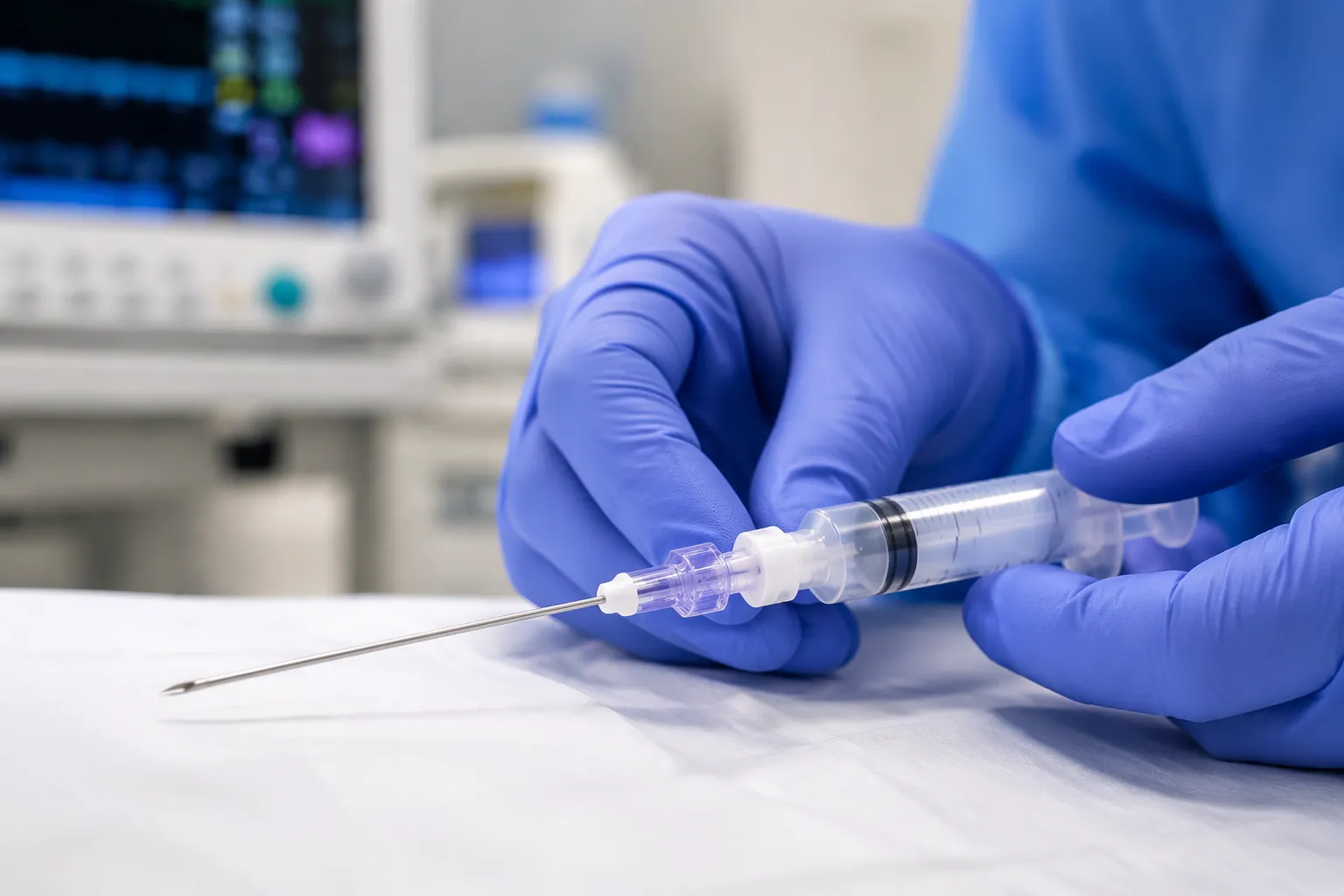
Needle tip design affects every regional anesthesia case. The choice affects block success, nerve injury risk, patient comfort, and department cost. Anesthesiologists make this decision every day. Small design differences create real clinical and financial effects.
This article compares blunt, short-bevel, pencil-point, and Tuohy nerve block needles. It gives a quick verdict on where each design works best. Readers will find nerve block pros and cons weighed across technical performance, clinical fit, regulatory status, and cost. That framework helps teams match each design to their own case mix, training level, and budget instead of following habit.
Key Takeaways
Sharp tips help with deep nerve blocks and accuracy, while blunt or rounded tips make the needle safer and feel better.
Short-bevel needles balance safety and precision. This makes them a good default choice for many ultrasound-guided blocks.
Pencil-point needles make patients more comfortable, but they may be harder to see on ultrasound.
Tuohy needles work best for continuous blocks. That is because their curved tip helps guide a catheter.
Pick the right needle for the block type: single-shot or continuous, and shallow or deep.
Nerve Block Pros and Cons at a Glance
Quick Comparison by Design
Each design has its own good points and bad points for regional anesthesia. The table below sums up the main pros and cons of common nerve block needles.
Design | Top Pros | Top Cons |
|---|---|---|
Blunt | Low cutting risk, strong tactile feedback | High penetration resistance, harder to advance |
Short-bevel | Separates tissue fibers, retains penetration | Moderate cutting risk if misdirected |
Pencil-point | Atraumatic spread, good patient comfort | Reduced echogenicity under ultrasound guidance |
Tuohy | Curved tip aids catheter placement | Catheter-related risks, less precise for single-shot |
How Tip Geometry Drives Outcomes
Tip geometry shapes three key results: penetration force, tactile feedback, and injectate spread. Cutting tips slice through tissue and move forward with less force. Separating tips push fibers apart and need more pressure. Rounded tips spread tissue gently and cause less trauma.
Tactile feedback works the same way. Blunt and rounded tips send clearer resistance signals to the operator. Sharp tips move smoothly but give less feel. Injectate spread also depends on tip shape. Separating and rounded tips spread local anesthetic more widely. Cutting tips deliver fluid along a narrower track.
These differences matter across nerve block techniques. A sharper tip is better for depth and precision. A blunter or rounded tip is better for safety margins. Knowing this trade-off helps clinicians match nerve block needles to each case.
Blunt Needles
Safety and Tactile Feedback
Blunt needles give up sharpness to gain control. The rounded tip pushes tissue fibers aside rather than slicing through them. This design lowers the cutting risk during needle insertion and protects nerve structures along the path. Operators feel a clear change in resistance as the tip passes through each tissue layer. That feedback helps them judge depth and stop before touching the nerve.
The higher penetration resistance is the main drawback. The needle needs more forward pressure to advance, and some operators find fine adjustments harder. Still, many clinicians accept this trade-off for the safety margin it gives in peripheral nerve blocks. The blunt tip also lowers the risks of accidental vascular or neural puncture. These advantages matter most when the target sits close to critical structures.
Best Clinical Fits and Cost
Blunt needles work well for superficial and fascial plane blocks. These targets sit at shallow depth, so the extra penetration force causes little trouble. Single-shot use fits the design well, because the needle stays in place for a short time. Common examples include fascial plane techniques and field blocks where the operator wants strong tactile cues under ultrasound guidance.
Regulatory status varies by product and region. Most blunt nerve block needles carry standard clearances such as FDA registration or CE marking, and buyers should confirm the documentation for each brand. Per-needle cost generally sits in the mid range across the market. Blunt designs rarely carry a premium price, and many departments find them cost-effective for high-volume superficial work. Teams should also weigh training needs, since the higher resistance demands a confident hand. Rare complications such as local anesthetic systemic toxicity depend more on dose and injection technique than on tip design, so protocol matters alongside needle choice. Overall, blunt needles serve regional anesthesia well when safety margins outrank speed.
Short-Bevel Needles
Precision and Nerve Safety
Short-bevel needles fall between the sharp cutting tip and the fully blunt design. The bevel is short enough to keep a firm point, but the tip tends to push nerve fibers apart instead of slicing them. This lowers injury risk while the needle still moves forward with reasonable force. Operators keep a useful level of tactile feedback, and the tip tracks well through muscle and fascia.
The design helps with precise needle insertion in ultrasound-guided nerve blocks. A short bevel holds a straighter path through soft tissue, so the tip stays close to the planned line. Good needle visualization under ultrasound guidance lets the operator confirm tip position before injection. These traits cut down avoidable complications during peripheral nerve blocks and support steady performance in ultrasound-guided regional anesthesia.
ShineArk's AN-N/AN-M Series Ultrasound Visible Nerve Block Needles show how far this design can go. The bilateral back bevel tip separates tissue fibers as the needle moves forward. A 360° echogenic 4x4 array micro-structure with laser-engraved surfaces keeps the shaft visible at different insertion angles. The 304 stainless steel shaft offers high elasticity, and a 500mm TPU extension tube allows smooth injection. Sizes run from 20G to 25G, and the line meets ISO13485 and CE/MDR standards. These advantages make the series one strong option among several short-bevel products on the market.
Best Clinical Fits and Cost
Short-bevel needles fit most single-shot peripheral and plexus blocks. They suit targets at moderate depth, where the operator needs both penetration and a margin of safety. Common uses include upper limb and lower limb blocks in ultrasound-guided PNBs, plus truncal work where the pleura sits nearby. Teams that value tactile feel and controlled advancement often make this design their default.
Regulatory clearance varies by brand, and buyers should check FDA registration or CE/MDR documentation for each product. Per-needle cost spans a wide range across suppliers, and premium echogenic models sit above basic versions. Departments can offset the difference through fewer repeat passes and shorter procedure times. Training needs stay modest, because the short bevel behaves much like a standard needle. Careful technique still matters, since dose control and injection pressure drive many complications more than tip shape does.
Pencil-Point Needles
Spread and Comfort Profile
A pencil-point tip ends in a smooth, rounded cone with a side hole. The tip pushes tissue aside instead of cutting it, so the needle goes in without tearing tissue. Patients often say they feel less discomfort during and after the block. Anesthesiology DFW notes that pencil-point spinal needles carry a lower risk of postdural puncture headache than cutting-tip needles of the same size. That comfort profile makes the design a good choice for regional anesthesia in awake or sensitive patients.
The rounded tip also gives a clear popping feel as it crosses thick muscle layers. ShineArk describes this clear pop as a helpful cue for finding safe tissue planes before the clinician injects pain medicine. One trade-off is weaker echogenicity. A smooth cone reflects fewer sound waves than a beveled or laser-etched shaft, so visibility under ultrasound guidance can suffer. Echogenic coatings that trap micro-air bubbles near the tip help, and Anesthesiology DFW reports that these enhanced needles shorten the time needed to see the tip. ShineArk data on lower back blocks shows a 5% nerve side effect rate for a 22G pencil-point needle versus 10% for an 18G short-bevel needle.
Best Clinical Fits and Cost
Pencil-point needles suit superficial blocks and cases that put patient comfort first. Leg blocks over thick muscle covers fit well, because the popping feedback helps the operator confirm depth. Single-shot peripheral nerve blocks at shallow targets also match the design. Clinicians should weigh the advantages against the possible drawbacks, mainly the reduced echogenic signal on older ultrasound systems.
Clearance varies by product, and buyers should confirm FDA registration or CE/MDR documents for each brand. Per-needle cost sits in the mid range, and echogenic versions cost more than plain tips. Departments can offset the price through fewer needle passes and lower complication rates. Careful technique still limits complications such as intravascular injection, so training matters as much as tip shape.
Tuohy Needles
Continuous Block Performance
The Tuohy needle has a curved tip at the end. This curve lets the operator slide a catheter in next to the target nerve, according to NYSORA. The same design also supports the loss-of-resistance technique. NYSORA describes an 18-gauge, 15 cm needle used to find the lumbar plexus psoas compartment, and then a catheter is threaded through the needle.
Aspect | Role in Practice |
|---|---|
Curved distal tip | Helps guide the catheter next to the nerve |
Loss-of-resistance technique | Confirms you are in the right space before threading |
A blunt Tuohy tip also gives a clear pop as it passes through fascia. Liu et al. report that this feel helps in fascia iliaca blocks. Operators still use ultrasound guidance to avoid injecting into the nerve. Depth control matters here, because the needle passes through several tissue layers before the catheter reaches the space around the nerve.
Best Clinical Fits and Cost
Tuohy needles work well for continuous peripheral nerve blocks, where a catheter stays in place to relieve pain after surgery. They fit regional anesthesia programs that need pain relief to last beyond a single shot. Single-shot nerve blocks avoid the catheter problems listed below, so teams should match the design to the case. The benefits come with some trade-offs:
Nerve injury after peripheral nerve blocks happens in about 0.02–0.04% of cases, and continuous techniques do not raise that rate, per PMC.
Catheter dislodgement and leakage are the main causes of block failure later on.
Catheter-related infection ranges from 0–3%, mostly under 1%, and the risk goes up after 4 days.
Mechanical damage during insertion or withdrawal can leave a piece of catheter behind.
Local anesthetic systemic toxicity is rare with continuous peripheral nerve blocks.
Subcutaneous tunneling with a Tuohy needle lowers dislodgement and infection, but it adds needlestick and kinking risks. Per-needle cost sits in the mid to upper range, and buyers should confirm FDA or CE/MDR clearance for each brand. Cannula-stylets and other accessories add to case cost. Careful technique limits most complications, and serious complications remain uncommon overall. Departments with a high volume of continuous cases often accept the higher unit price for the workflow benefits.
Comparing Nerve Block Needles on Key Factors
Safety, Comfort, and Ease of Use
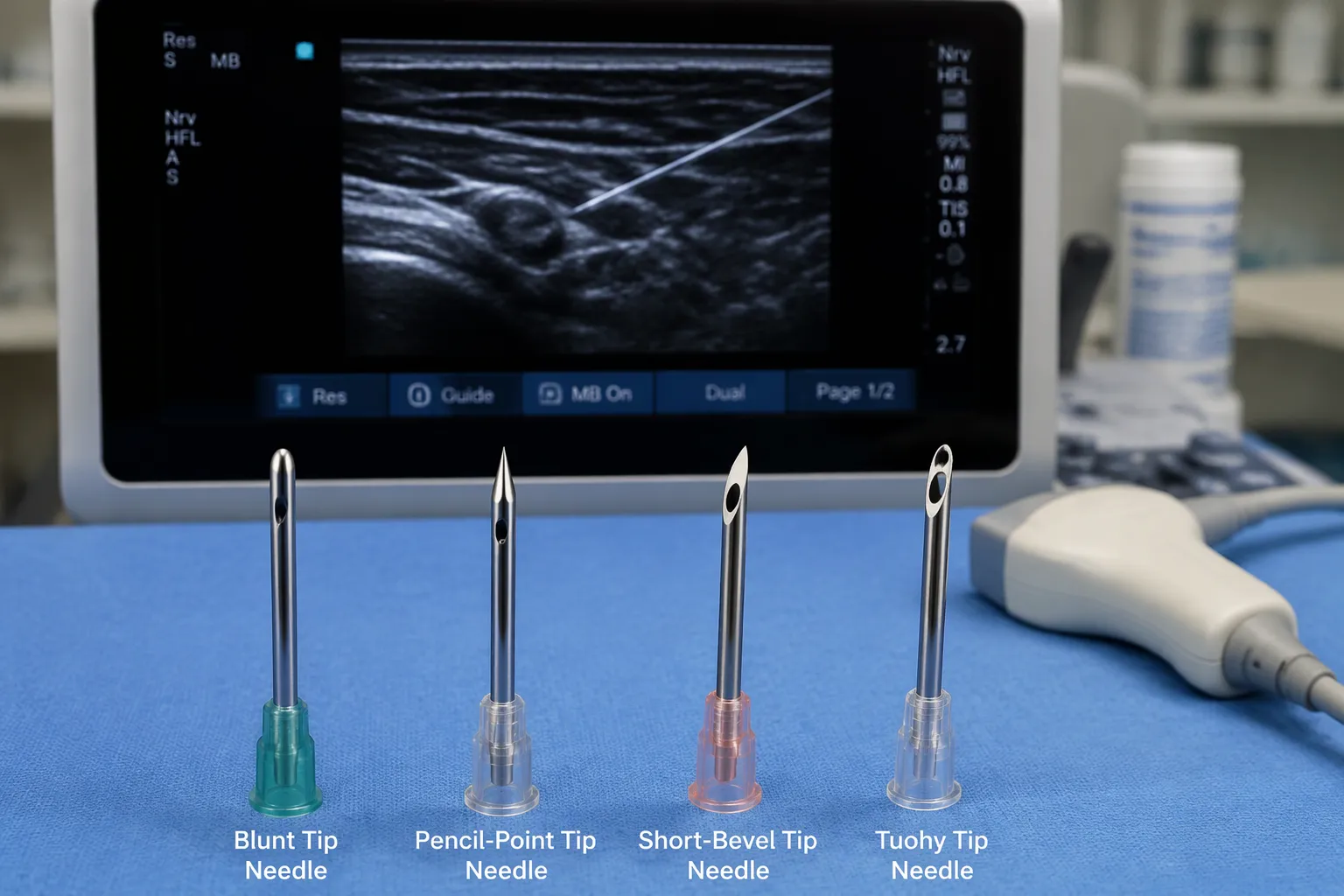
Safety is not the same for all four designs. Blunt and pencil-point tips push tissue aside, so they have the lowest cutting risk during insertion. Short-bevel tips separate fibers but keep a firm point, which puts them in the middle. Tuohy tips are blunt and curved, and they protect tissue well during catheter threading. Each design gives up some sharpness for control, and that trade shapes the risks and limits of daily practice.
Comfort follows a similar pattern. Pencil-point tips cause the least discomfort, and blunt tips come close. Short-bevel tips feel sharper to awake patients, while Tuohy needles serve catheter cases where comfort matters less than workflow. Ease of use favors sharp tips for depth and blunt tips for feel. Short-bevel designs balance both, and many clinicians treat them as the default for ultrasound-guided nerve blocks.
Ultrasound guidance changes the ranking. Echogenic short-bevel and Tuohy shafts show up well on screen, and pencil-point tips reflect less sound. Blunt tips sit in the middle. Operators who rely on clear needle tracking during ultrasound-guided regional anesthesia often favor designs with strong echogenic features. The advantages of each tip show up best when the operator matches the design to the target depth and the patient's tolerance.
Regulatory Clearance and Cost per Case
Clearance status varies by product, not by tip shape. Most commercial block needles carry FDA clearance or CE/MDR marking, and buyers should confirm the documents for each brand and size. No design holds a regulatory edge over the others in principle. The paperwork burden falls on the supplier, and departments should verify certificates before purchase.
Cost per case depends on unit price, accessory needs, and repeat passes. Basic blunt and pencil-point needles usually sit in the mid range. Echogenic short-bevel models cost more, and Tuohy kits add catheter and accessory costs. Fewer repeat passes and shorter procedure times can offset a higher unit price. Teams should also count the cost of managing complications, since nerve block failure and local anesthetic systemic toxicity drive unplanned spending.
Technique limits most complications more than tip design does. Dose control, injection pressure, and clear needle visualization under ultrasound guidance matter across all four designs. Careful protocols reduce complications in peripheral nerve blocks, and they lower complications in continuous peripheral nerve blocks as well. Departments that track complications by design can compare real costs over time. That data turns a price list into a practical budget tool for regional anesthesia and for every nerve block procedures pathway a team runs.
Matching Nerve Block Needles to Scenarios
Single-Shot Versus Continuous Blocks
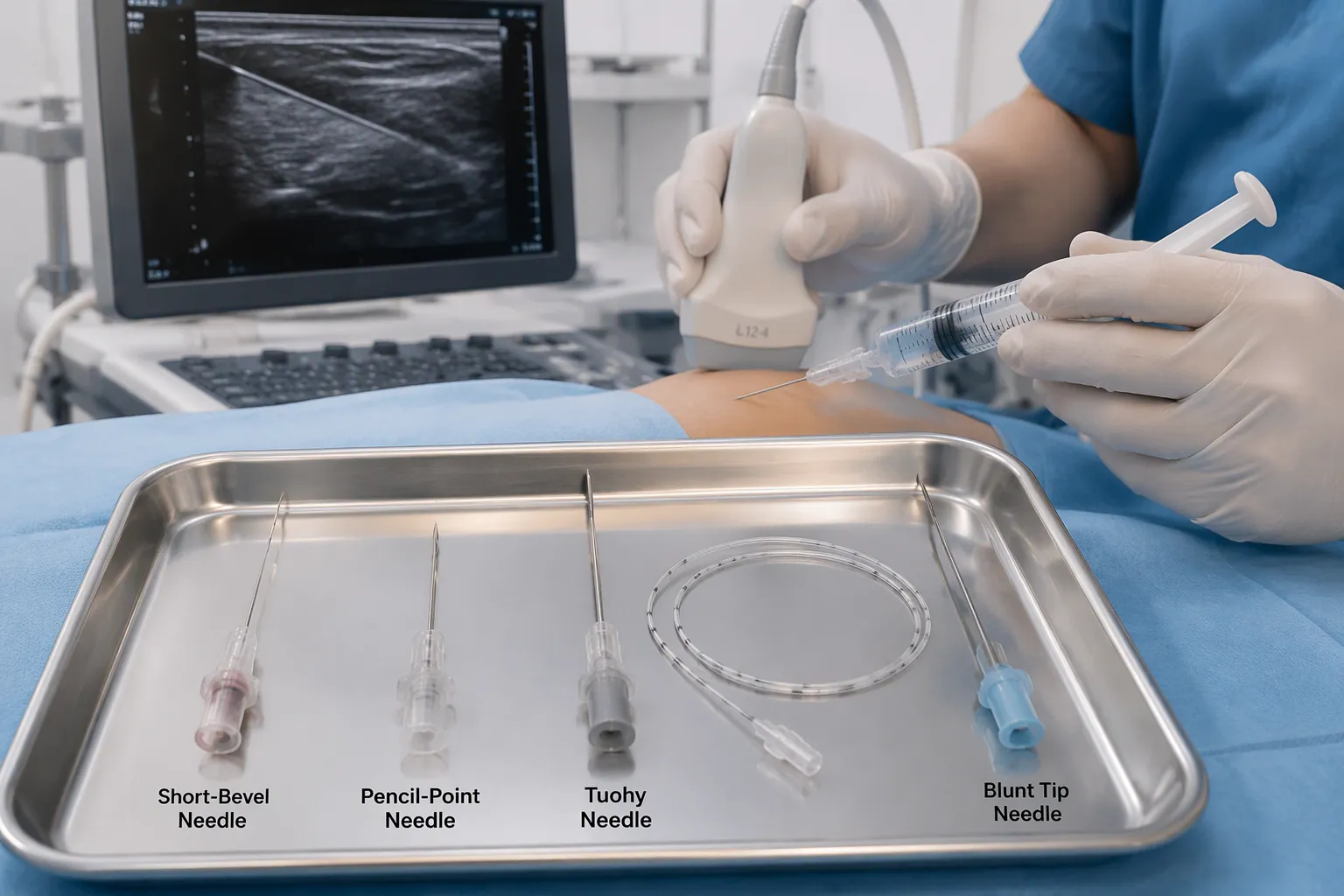
Single-shot cases work best with a tip that moves smoothly to the target and then comes out. Short-bevel and pencil-point designs fit this pattern well. Both help with exact placement under ultrasound guidance, and both keep tissue damage low for a quick pass. Blunt tips also work here when the target is shallow and the operator wants a wide safety margin. Unit cost stays low for these single-use designs, and most departments keep them as everyday items.
Continuous cases change the math. A Tuohy needle earns its place because the curved tip guides a catheter alongside the nerve. Teams running continuous peripheral nerve blocks accept a higher unit cost and added catheter risks in exchange for longer pain relief. Catheter dislodgement, leakage, and infection (roughly 0–3%, mostly under 1%, per PMC) are the complications to watch. Careful tunneling and early review limit these problems. Catheter threading also takes practice, so training level should shape the choice as much as price does.
Superficial Versus Deep Blocks
Depth decides how much sharpness a clinician needs. Deep targets need a firm point that holds a straight path through several tissue layers. Short-bevel needles meet that need and still push fibers apart rather than cut them. Sharp cutting tips help with precision at depth, but they raise the risk of hidden injury along the track. Operators working near the pleura or major vessels often prefer the extra control a short bevel provides.
Superficial and fascial plane work favors the other end of the spectrum. Blunt and pencil-point tips push tissue aside, so safety margins grow and tactile feedback gets sharper. Pencil-point designs add comfort for awake patients. Genicular nerve blocks and other knee work over thick muscle suit this rounded profile, where the pop through fascia confirms depth. Sensitive patients handle these tips better during longer awake procedures.
Ultrasound guidance shifts the balance again. Echogenic shafts improve needle tracking during ultrasound-guided regional anesthesia, and that visibility lowers complications across every design. Clear needle tracking shortens the search for the target. Operators should weigh image quality alongside tip shape when they pick nerve block needles.
The table below maps common scenarios to the design that fits best.
Scenario | Best-Fit Design | Why It Fits |
|---|---|---|
Single-shot superficial block | Pencil-point or blunt | Atraumatic spread, strong feel, comfort |
Single-shot deep plexus block | Short-bevel | Holds a straight path, separates fibers |
Continuous catheter case | Tuohy | Curved tip guides the catheter |
Fascial plane or field block | Blunt | Wide safety margin at shallow depth |
No single design wins every case. Sharper tips favor depth and precision, and blunter or rounded tips favor safety margins. That trade-off drives every choice in this table. Budget and case mix should guide the final call, since a department with many continuous cases needs a different stock profile than one focused on single-shot work.
Good nerve block techniques also depend on dose control and injection pressure. These factors shape local anesthetic systemic toxicity risk more than tip shape does. Teams that track outcomes by scenario can refine their nerve block procedure over time. That habit lifts nerve block effectiveness and trims avoidable complications in ultrasound-guided PNBs and in regional anesthesia generally. A thoughtful match between design and scenario serves patients better than a single default needle.
Tip design involves a clear trade-off. Sharp tips are better for precision and depth. Blunter or rounded tips are better for safety margins and tactile feedback. No single design works best in every case.
Readers can use a simple framework. Single-shot versus continuous blocks guide the first choice. Superficial versus deep targets guide the second. This logic turns nerve block pros and cons into a practical selection tool for peripheral nerve blocks.
Teams should weigh case mix, training level, and budget against each design's strengths. Careful technique limits complications across all four designs. Good judgment about regional anesthesia matters more than any single needle. That approach keeps regional anesthesia safe and effective.
FAQ
Which needle tip causes the least nerve damage?
Rounded and blunt tips push tissue fibers aside instead of cutting them. Short-bevel tips separate fibers too, but they keep a firm point. Sharp cutting tips carry the highest cutting risk. Technique and needle visualization still shape outcomes more than tip shape alone.
Do pencil-point needles work well under ultrasound?
They reflect less sound than beveled or laser-etched shafts. Echogenic coatings that trap micro-air bubbles near the tip improve visibility. Operators should weigh image quality against the comfort benefits. Many clinicians reserve pencil-point tips for superficial targets where tracking is easier.
When should a team stock Tuohy needles?
Continuous catheter cases justify the higher unit cost. The curved tip guides the catheter alongside the nerve. Teams running mostly single-shot blocks gain little from this design. Catheter dislodgement, leakage, and infection are the main complications to monitor.
Does a sharper tip reduce block failure?
Not on its own. Sharp tips favor depth and precision, and blunt tips favor safety margins. Block success depends on correct tip placement, dose control, and injection pressure. Clear needle tracking under ultrasound lowers complications across every design.
How should a department choose between designs?
Match the design to the case mix. Single-shot and superficial work suits pencil-point or blunt tips. Deep plexus blocks favor short-bevel needles. Continuous programs need Tuohy needles. Training level and budget shape the final call, and careful technique limits complications in every scenario.