Every manufacturer of ultrasound-visible needles claims the same thing: the needle is easy to see. The claim is not very informative, because visibility is not a property of the needle alone. It is a property of the needle, the angle of insertion, the tissue, the probe and the settings on the machine.
What differs between products is the mechanism used to return sound to the transducer, and each mechanism has a distinct behaviour when the insertion angle steepens. This article compares the three approaches that dominate the market — laser-engraved micro-structures, corner-cube reflectors, and surface coatings — and explains what each one is actually doing.
Competitor technologies described here are based on publicly available product information and published materials. Descriptions are simplified for comparison; always confirm current specifications with the manufacturer.
The Physics, Briefly
Ultrasound imaging of a needle depends on acoustic impedance mismatch between metal and tissue. A smooth steel cannula reflects sound strongly, but it reflects it specularly — like a mirror. The echo returns to the transducer only when the needle surface is close to perpendicular to the beam.
That geometry is what fails in clinical practice. At a shallow insertion angle the shaft is roughly perpendicular to the beam and appears bright. As the approach steepens toward 60–70°, the reflected beam is deflected away from the transducer, and the needle fades regardless of how polished it is.
There are only three ways to solve this:
Change the surface geometry so that some facets always face the beam (engraving, grooving, dimpling).
Use retroreflective structures that send sound back along its incoming path over a wide range of angles (corner cubes).
Change the surface material to scatter rather than reflect (coatings, sandblasting).
Every commercial "echogenic" needle is a variation on one of these three.
Technology 1: 360° Laser-Engraved Micro-Array
How It Works
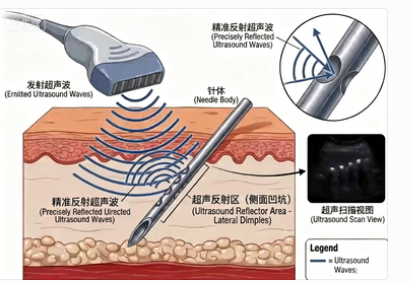
A pattern of small laser-engraved cavities is cut into the cannula near the tip, distributed around the full circumference rather than on one face. Each cavity presents a small edge or pocket that scatters sound diffusely instead of reflecting it in a single direction.
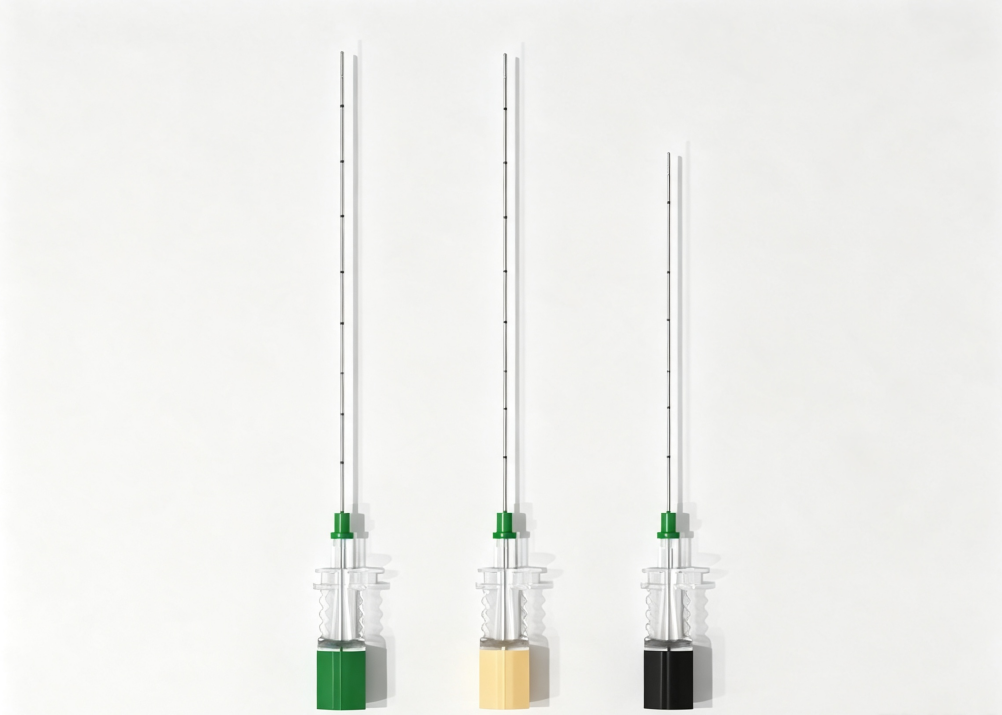
ShineArk's AN-N series uses a 4×4 array of engravings arranged 360° around the tip. With cavities distributed circumferentially, the needle presents scattering features to the beam at any rotational orientation — which matters because the operator rotates the needle during a block, and because an out-of-plane approach changes the effective angle without warning.
What It Does Well
Visibility is largely independent of needle rotation, since the array is not confined to one side.
The pattern is integral to the metal. There is no coating to delaminate, flake, or wear off during insertion.
Works across a broad band of angles, including the steep approaches where smooth needles disappear.
Trade-Offs to Understand
Engraving creates microscopic surface features. Depth and edge quality must be controlled, because aggressive engraving can affect shaft stiffness or create sites for stress concentration. This is a process-control question, and it is fair to ask a supplier for their engraving depth specification and a fatigue/bend test summary.
More engraved length means more visible shaft, which is not always desirable: an over-bright shaft can obscure the tip and make tip identification harder. Enhancement should be strongest where the operator needs it — at the tip.
Technology 2: Corner-Cube / Cornerstone Reflectors
How It Works
Instead of random scattering, this approach uses trihedral (corner-cube) retroreflectors — small three-sided cavities that return sound toward its source across a wide range of incidence angles. PAJUNK's SonoPlex family, built around its Cornerstone reflector design, is the best-known commercial example, and Hakko's corner-cube designs follow the same principle.
What It Does Well
Retroreflection is the most angle-tolerant of the three mechanisms in theory. Corner cubes are used in optics and radar for exactly this reason.
The reflector bands are discrete and well defined, which can produce a crisp, repeating signature along the shaft that experienced operators find easy to track.
Trade-Offs to Understand
Discrete bands mean discontinuous visibility. Between reflector bands the shaft behaves like a plain cannula. Tip identification still depends on how the distal-most pattern is positioned.
Manufacturing precision matters. A corner cube only retroreflects if all three faces are formed accurately. At needle scale this is demanding, and it is one reason the technology is associated with premium pricing.
Shaft-brightness bias. Dense reflector bands can make the shaft very conspicuous while the tip remains the hardest part to confirm. Operators should be trained to look for the tip signature, not the brightest part of the image.
Technology 3: Polymer Coatings, Sandblasting and Chemical Etching
How It Works
Rather than cutting geometry into the steel, these methods modify the surface: a polymer layer with embedded particles, a blasted matte finish, or an etched micro-relief. Vygon's Echoplex+ range and ICU Medical's EchoGlo (grooved surfaces) are examples of this family, though the specific mechanisms differ between products.
What It Does Well
A roughened or coated surface scatters sound diffusely, improving visibility at angles where a polished shaft would vanish.
Coating processes can be applied to existing cannula stock, which can make them cost-efficient at scale.
Surface treatment does not alter the underlying tube dimensions, so the mechanical behaviour of the needle is largely unchanged.
Trade-Offs to Understand
Coating durability is the central question. A polymer layer sits on top of the metal. During insertion through fascia it is subject to abrasion. Delamination would mean particulate at the puncture site and a loss of echogenicity in exactly the segment that was enhanced. Ask any supplier using a coating for adhesion and particulate test data, not a description of the chemistry.
Sandblasting and etching are integral to the metal and do not delaminate, but the achievable feature depth is shallower than laser engraving, and the scattering pattern is less structured.
Batch consistency depends on process control of blast pressure, grit, or etch time. It is worth asking how these parameters are monitored.
A Fourth Category, Often Confused with the Others
Sensor-Based Tip Tracking
Systems that use an electromagnetic sensor in the needle tip to project the tip position onto the ultrasound image (for example B. Braun's Onvision) are sometimes marketed alongside echogenic needles. They solve the same clinical problem by a completely different route: the tip is tracked electronically rather than made reflective.
This is not a surface technology, it requires a compatible console, and it adds cost and workflow steps. It is a legitimate solution — but it should not be compared on the same axis as engraving or coatings, and marketing material that blurs the distinction is worth reading carefully.
Comparison at a Glance
The following table summarises the main differences between the three surface-enhancement approaches discussed above.
| Comparison Factor | 360° Laser Engraving | Cornerstone / Corner-Cube Reflectors | Polymer Coating / Blasting / Etching |
|---|---|---|---|
| Mechanism | Diffuse scatter from circumferential cavities | Trihedral retroreflection | Surface roughening or particle scatter |
| Angle Tolerance | Good across a wide band | Very good in theory; banded in practice | Moderate to good, depends on process |
| Rotation Independence | High (360° array) | Moderate (depends on pattern placement) | Moderate |
| Durability | Integral to metal, no delamination | Integral to metal | Coating: adhesion risk. Blasting/etching: integral |
| Visible Length | Tunable via pattern length | Discrete bands | Usually uniform along treated length |
| Tip vs Shaft Balance | Can be tuned toward the tip | Shaft-dominant if bands are dense | Often uniform, harder to tune |
| Process Control Demand | Engraving depth and edge quality | High-precision cavity forming | Blast/etch consistency, coating adhesion |
| Typical Positioning | Mid to premium | Premium | Mid range, cost-sensitive |
How to Compare Them Objectively
Product images are not evidence. If you want to compare technologies rather than brochures, standardise the test:
Use a tissue-mimicking phantom, not water. Water is the most forgiving medium possible and will make almost any needle look good.
Fix the angle. Capture at 30°, 45°, 60° and 70° at the same depth and gain. Most published images stop at 45°, which is precisely where the technologies have not yet separated.
Test rotation. Rotate the needle in 45° increments at a fixed angle. A 360° pattern should hold visibility; a single-face pattern will not.
Score the tip, not the shaft. Ask three blinded clinicians to identify the tip position, and measure error against a reference mark. This is the only metric that reflects clinical use.
Repeat after insertion cycles. Pass the needle through phantom fascia several times and re-image. Coatings may change; engraving should not.
Which Technology Should You Specify?
It depends on what you are buying for:
Steep, deep approaches (obese patients, deep plexus, paramedian approaches): angle tolerance and tip specificity matter most. Favour 360° engraving or well-formed retroreflectors, and confirm with steep-angle imaging.
High-volume superficial blocks where cost is the driver: a uniform surface treatment is often adequate, provided the tip still reads clearly.
Teaching and training environments: shaft visibility helps learners follow the needle path, but a very bright shaft can mask the tip. Look for a design that balances both.
Markets with strict particulate and biocompatibility scrutiny: integral surface features avoid the coating questions entirely.
For medical device procurement teams: Technology selection should be supported by product specifications, appropriate verification data, and clinical-use requirements. When evaluating a supplier, also consider its manufacturing capability, quality management system and ability to provide consistent product documentation. See our guide on how to choose a nerve block needle manufacturer.
The Honest Summary
All three technologies work. The differences are in where they work — at which angles, at which rotational orientations, and for how long during a procedure. A supplier who can show steep-angle, multi-rotation, phantom-based imaging is telling you something real. A supplier who shows one glossy image at 40° is telling you about their photographer.
ShineArk's approach is the first category: a patented 360° imaging reflection design (Chinese invention patent ZL 2019 1 1149952.9) with a 4×4 engraved array around the tip, integral to a 304 medical stainless steel cannula, combined with a short bevel and bilateral back bevel at the tip.
For specification data, steep-angle imaging and samples for your own bench test, see the AN-N nerve block needle range.
Frequently Asked Questions
Is a laser-engraved needle better than a coated one?
Not universally. Engraving is integral to the metal and cannot delaminate, which removes one failure mode. Coatings can be more uniform along the shaft and cheaper to produce. The decisive question is performance at the angles you actually use, which is why steep-angle bench testing matters more than the technology label.
Do corner-cube reflectors work better at steep angles?
Retroreflection is intrinsically angle-tolerant, and well-made corner cubes perform strongly. In practice, visibility is banded: it is excellent at the reflector positions and ordinary between them. Tip identification still depends on the distal pattern placement.
Does "echogenic" mean the same thing across suppliers?
No. There is no standard definition or minimum performance threshold. The term describes an intent to enhance reflectivity, and each manufacturer implements it differently. Always ask for the mechanism, the location of the enhancement, and imaging at steep angles.
Can echogenic features affect needle strength?
Surface features can, in principle, act as stress concentrators if engraved too deeply or too densely. This is a process control issue rather than an inherent flaw, and it is reasonable to request bend and fatigue test data alongside the engraving specification.
Why do my needles look bright in water but poorly in patients?
Water provides near-ideal acoustic conditions with no attenuation and no tissue interfaces. Muscle, fat and fascia attenuate and scatter sound far more. A needle that performs only in water has not been tested under conditions that resemble clinical use.
Looking for an Echogenic Nerve Block Needle Supplier?
Explore ShineArk's AN-N nerve block needle range featuring a 360° laser-engraved micro-array design. Contact our team for product specifications, technical information, samples and OEM/ODM requirements.
Explore AN-N Nerve Block NeedlesDiscuss Your Sourcing Requirements