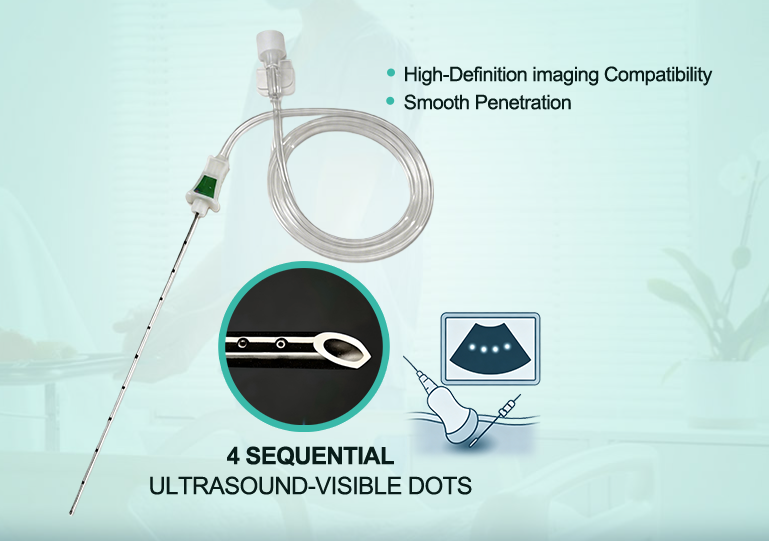
An echogenic needle for nerve block is a needle designed with surface features that help return ultrasound echoes to the transducer, making the needle shaft or tip easier to identify during ultrasound-guided procedures under suitable imaging conditions. These needles are used in regional anesthesia applications where clinicians rely on real-time ultrasound imaging to observe needle advancement and positioning.
ShineArk Medical's AN-N/AN-M series features a laser-engraved micro-reflective structure and a 360-degree acoustic reflection design. When evaluating an echogenic nerve block needle, buyers should consider its surface technology, needle gauge, length, tip configuration, intended use, and supporting product documentation.
What Does "Echogenic" Mean in Medical Needles?
Echogenicity refers to a material or structure's ability to produce echoes that can be detected by ultrasound imaging equipment. In medical needles, surface geometry and other design features can influence how ultrasound waves interact with the needle and how much reflected energy returns to the transducer.
A needle may appear bright in an ultrasound image when reflected echoes return effectively to the probe. However, image brightness alone does not guarantee that the needle tip can always be identified accurately. Visualization also depends on the insertion angle, ultrasound settings, tissue conditions, and operator technique.
How Does Ultrasound Show a Needle?
An ultrasound transducer sends high-frequency sound waves into the body and receives returning echoes. The imaging system processes these echoes to create a real-time image of the surrounding anatomy and visible instruments.
When a needle is positioned at an angle that directs reflected sound away from the transducer, the needle may become less conspicuous. Echogenic needle designs aim to improve the return of echoes under relevant imaging conditions.
Why Is Needle Tip Identification Important?
In ultrasound-guided procedures, clinicians need to distinguish the needle tip from the surrounding shaft and nearby anatomical structures. Seeing a portion of the shaft does not necessarily mean the tip is clearly visible. For this reason, needle design should be evaluated in the context of the intended procedure and the imaging conditions in which it will be used.
What Is an Echogenic Needle Used for in Nerve Blocks?
Echogenic nerve block needles are designed for use in ultrasound-guided regional anesthesia applications where needle visualization is an important consideration. The specific indication depends on the product's intended use, labeling, and applicable regulatory requirements.
Ultrasound-Guided Peripheral Nerve Blocks
Ultrasound-guided peripheral nerve blocks involve imaging relevant anatomy while a clinician positions a needle for the intended regional anesthesia procedure. An echogenic needle may help make the instrument more distinguishable in the ultrasound image, depending on the needle design and scanning conditions.
Real-Time Needle Visualization
Needle visualization is influenced by the relationship between the transducer, needle, and target anatomy. Echogenic features are intended to improve ultrasound echo return, but they do not replace appropriate imaging technique, clinical training, or continuous assessment of needle position.
What Makes ShineArk AN-N/AN-M Series Echogenic?
ShineArk Medical presents its AN-N/AN-M series as ultrasound-visible nerve block needles incorporating specialized surface and tip design features. The product information highlights a 4×4 laser-engraved micro-reflective structure and a 360-degree acoustic reflection design.
4×4 Laser-Engraved Micro-Reflective Structure
The 4×4 micro-structure is a surface design feature intended to influence ultrasound reflection. When describing this technology, it is important to distinguish the physical structure from measured performance. Actual visibility should be assessed using suitable imaging conditions and documented evaluation methods.
360-Degree Acoustic Reflection Design
The 360-degree design describes the intended circumferential arrangement of the needle's reflective features. It is designed to support ultrasound visibility across relevant needle orientations. The term should not be interpreted as a guarantee of identical visibility at every insertion angle or in every patient.
Bilateral Bevel and Needle Shaft Markings
Bevel geometry and shaft markings are additional features that buyers may evaluate when reviewing a needle. Their relevance depends on the product configuration, intended application, and user requirements. Refer to the manufacturer's current product specifications for model-specific details.
Echogenic Needle vs. Conventional Needle
The main difference between an echogenic needle and a conventional needle is the design approach used to influence ultrasound reflection. A conventional needle may have a relatively smooth surface, while an echogenic needle incorporates features intended to improve the return of ultrasound echoes.
| Comparison Factor | Conventional Needle | Echogenic Needle |
|---|---|---|
| Surface design | Depends on the specific model | Includes features designed to enhance echogenicity |
| Ultrasound visibility | Depends on needle orientation and imaging conditions | Designed to improve echo return under suitable conditions |
| Tip identification | Depends on tip geometry and imaging technique | Depends on echogenic features, tip design, and imaging technique |
| Selection criteria | Intended use, gauge, length, and compatibility | The same criteria, plus echogenic performance |
Neither category should be assumed to perform identically across all clinical situations. Buyers should evaluate the intended use, product specifications, and available performance evidence before making a selection.
How to Choose an Echogenic Needle for Nerve Block
Needle Gauge and Length
Gauge and length should be selected according to the intended procedure, clinical requirements, and applicable product instructions. Buyers should verify the available specifications for each model instead of assuming that every size is offered.
Needle Tip and Bevel Design
Tip configuration can influence needle handling and should be considered alongside the intended application. Confirm the exact tip and bevel design from the product documentation.
Echogenic Surface Technology
Ask the manufacturer how the echogenic surface is designed and whether supporting images, test reports, or other evaluation documents are available. Where comparative claims are made, check whether the products were assessed under comparable conditions.
Sterility, Packaging, and Product Documentation
Confirm the product's intended use, single-use status where applicable, sterilization information, packaging configuration, labeling, and relevant regulatory documentation. Requirements vary by product and destination market.
Frequently Asked Questions
What is an echogenic needle for nerve block?
It is a needle designed with features intended to improve ultrasound echo return and help clinicians visualize the needle during ultrasound-guided nerve block procedures.
Are echogenic needles visible under ultrasound?
They are designed to improve visibility, but the actual image depends on needle orientation, probe position, imaging settings, tissue conditions, and the specific needle design.
What makes an echogenic needle different from a standard needle?
The primary distinction is its surface or geometric features intended to enhance ultrasound reflection. Exact performance differences should be evaluated using product-specific evidence.
What should buyers check when selecting an echogenic needle?
Review the intended use, gauge, length, tip design, echogenic technology, packaging, sterilization information, quality documentation, and applicable regulatory requirements.
Where can buyers find echogenic nerve block needle specifications?
Buyers should consult the manufacturer's product page and current technical documentation for available models, dimensions, packaging, and other confirmed specifications.
Explore ShineArk Echogenic Nerve Block Needles
ShineArk Medical offers an AN-N/AN-M series of ultrasound-visible nerve block needles featuring a 4×4 laser-engraved micro-reflective structure and a 360-degree acoustic reflection design. Medical device buyers and distributors can review the product information and contact ShineArk to discuss model availability, technical documentation, and sourcing requirements.
Explore Echogenic Nerve Block Needles
For product specifications, OEM/ODM discussions, or bulk purchasing inquiries, contact ShineArk Medical with your intended application, required sizes, target market, and order requirements.